

If you have spent any time looking into corporate sustainability, carbon offsetting, or environmental project development, you have almost certainly encountered the acronym VCS. Standing for the Verified Carbon Standard, it is the world’s most widely used greenhouse gas crediting program. Millions of tonnes of carbon emissions are tracked, verified, and traded under its umbrella every single year.
However, understanding how the standard operates and how an initiative actually moves from an idea to a certified, tradable credit can feel like navigating a maze of technical acronyms and compliance rules. Whether you are a business looking to leverage verra carbon credits for net-zero goals or a project developer figuring out how verra’s verified carbon standard applies to your land, having a clear roadmap is essential.
1. What Is the Verified Carbon Standard (VCS)?
Managed by Verra, a non-profit organization established in 2005, the verified carbon standard provides the rules, methodologies, and registry infrastructure required to certify genuine greenhouse gas emission reductions and removals.
The core purpose of the standard is to ensure environmental integrity. To issue a valid credit, a project must prove that its climate benefits are:
- Real: Backed by hard scientific data and measurable impact.
- Additional: Meaning the emission reductions would not have happened without the financial incentive of the carbon project.
- Permanent: Protected against reversal or accidental loss (such as through pooled buffer accounts for natural risks like fire or pests).
- Verifiable: Rigorously audited by independent third-party organizations.
Projects that successfully navigate this framework generate Verified Carbon Units (VCUs), which can then be sold on voluntary carbon markets to help organizations offset their footprint.
2. How Does VCS Certification Work?
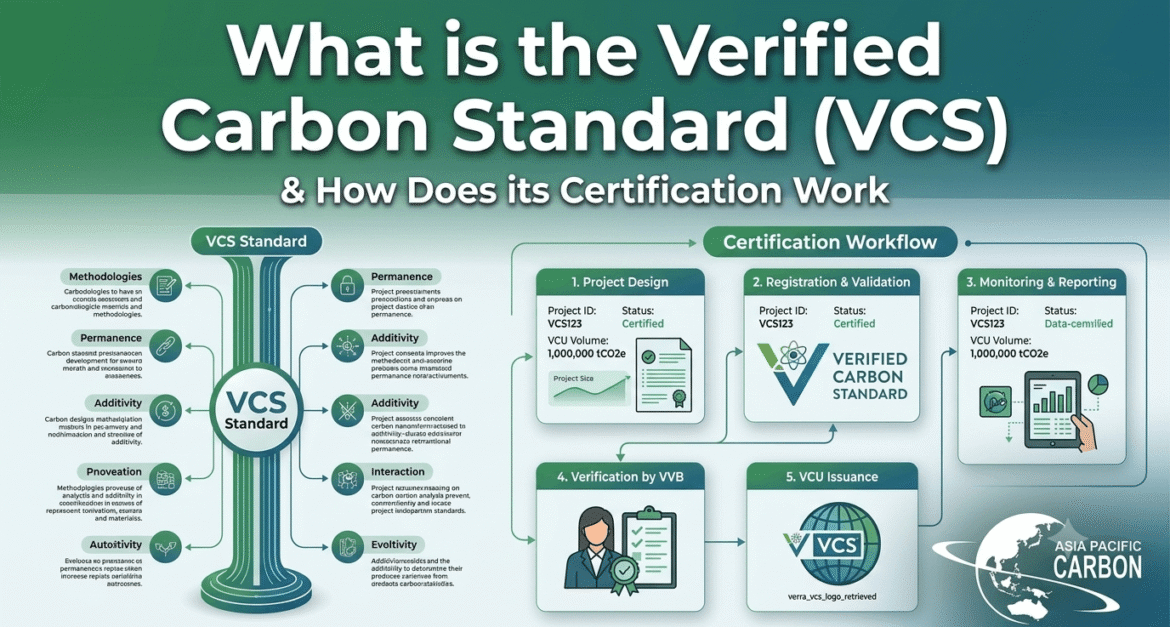
Getting a project certified under the verified carbon standards requires a strict, multi-step lifecycle. While the exact requirements depend on whether you are working in Agriculture, Forestry, and Other Land Use (AFOLU), renewable energy, or industrial efficiency, the general certification pathway follows four key stages:
Step 1: Project Design and Methodology Selection
Every project must select an approved Verra methodology that matches its specific activity—such as REDD+, Improved Forest Management (IFM), or regenerative agriculture. During this phase, developers draft a detailed Project Design Document (PDD) outlining the baseline emissions scenario, monitoring plans, and expected carbon yields.
Step 2: Independent Validation
Once the PDD is complete, it cannot just be published on faith. An independent, accredited third-party auditor known as a Validation and Verification Body (VVB) reviews the documentation. The VVB conducts desk audits and field inspections to verify that the project design meets every requirement of verra’s verified carbon standard.
Step 3: Registration on the Verra Registry
After successfully passing validation, the project is officially registered on the public Verra Registry. This central database tracks the lifecycle of every credit, ensuring that each VCU has a unique serial number and preventing double-counting.
Step 4: Monitoring, Verification, and Issuance
As the project operates over time, developers must continuously monitor carbon sequestration or emission reductions. These periodic monitoring reports are sent back to an independent VVB for verification. Once verified, Verra issues the corresponding VCUs into the project’s registry account, ready to be retired or traded.
3. Navigating the Process with Expert Guidance
Because the Verra certification process involves complex scientific modeling, legal frameworks, and stringent registry rules, trying to do it alone can lead to costly delays. This is where partnering with an experienced VERRA carbon credit consultant becomes invaluable.
Specialized developers bring deep technical expertise to the table, ensuring that your baselines are accurate, your methodologies are properly aligned, and your project documentation sails smoothly through the Vents and Verra validation pipelines. Regional leaders like Asia Pacific Carbon combine this rigorous technical mastery with boots-on-the-ground experience across the Asia-Pacific region, helping landowners and corporations bring high-integrity carbon projects to life.
Turning Standards Into Sustainable Action
The Verified Carbon Standard is more than just a regulatory framework it is the foundational trust mechanism that powers the global voluntary carbon market. By demanding high integrity, rigorous science, and transparent verification, VCS ensures that climate investments genuinely protect our planet’s future.
Ready to explore how the Verra framework applies to your organization or land? Reach out to an expert advisory team today to navigate your carbon journey with clarity and confidence.